
ANTIPOACHING AIRCRAFT: CURRENT PROJECT
CRITICAL NEED
You can Join Us and help deliver more needed airplanes to parks and reserves in Africa. ALL DONATIONS will go SOLEY to the project.
Wilderness Conservancy has provided nine aircraft to African wildlife parks, three of them since 2014 to aid in saving the few remaining elephants and re-introducing rhino which have been killed off by poachers. Two of the recent aircraft are new BatHawks in Mozambique's Gorongosa National Park and Niassa Wilderness and the third is a Bellanca 8GCBC "Scout" donated to Namibia's Ongava Game Reserve. The aircrafts' missions are dedicated to antipoaching patrol as well as related flora and fauna survey.
Ongava Game Reserve
Ongava is a 68,000-acre game reserve situated along the southern boundary of Etosha National Park which is Namibia's premier game reserves with over 125 square miles to cover in anti-poaching surveilllance. Lions, black and white rhinos, elephants, giraffe and several stunning species of antelope, including rare black-faced impala, are at home on the reserve and need protection. read more
Gorongosa National Park
This park/game reserve was, before the Rhodesian bush war, and the Mozambique civil war, the premier reserve in Mozambique. The effort to bring back the wildlife of the Gorongosa began earlier in 2015 headed by two Americans, Mike Marchington and Greg Carr. Mike and Greg have liaised with the Mozambique government and have been training and equipping local men in large numbers as game management teams inclusive of antipoaching units. They have also brought in wildlife from other areas to reestablish viable populations. read more
You can Join Us and help deliver more airplanes to parks and reserves in Africa. ALL DONATIONS will go SOLEY to the project.
ANTIPOACHING AIRCRAFT › HISTORY › Summary :
Zimbabwe: two Bellanca 8GCBC Scouts – one was lost in a landing accident and replaced by another. Crispin Jokopo, our pilot, had landed in a farmer’s field to pick up a catch of AK-47 automatic rifles hidden there by poachers. Unknowingly, his left main gear tire had been punctured by a thorn. The air leaked out slowly by when he landed, the flat tire caused a bad accident. Crispin was not hurt but the Scout was totaled.
KwaZulu/Natal, South Africa: two Bellanca 8GCBC Scouts – one was totaled in an accident while flying low level circles around a white rhino that had been shot with an arrow by a German doctor who was high on ganga. The plane stalled and crashed and the pilot was killed. The aircraft was replaced by another Scout.
Kruger National Park: two new American Champion 8GCBC “Super Scouts”. Funded by donations from the Republic of China on Taiwan.
South Africa National Parks and the South African Police Service: Cessna U206F. When the SA police saw that it worked very well in various criminal matter, the police service then allowed the ESPU to use its police owned aircraft. Dr. Cleaves brought the Cessna home and used it in humanitarian missions to Baja California, Mexico. The big thing that brought the SAPS to allow its animal law enforcement people to use its own aircraft was the time when our Cessna, flown by a police pilot, spotted two very large refrigerated trucks being driven from Cape Town to a Namibian port to be stopped before leaving SA and found a huge load of abalone. The trucks were confiscated along with their cargos. The abalone were sold by the SA government for more than a million dollars on the international market.
Gorongosa National Park, Mozambique: 1 BatHawk LSA (Light Sport Aircraft).
Niassa Wildlife area, Mozambique: 1 BatHawk LSA
Shamwari Game Reserve in the Eastern Cape of South Africa: 1 Aeronca Champion – later traded for a helicopter and used in both the Eastern Cape and in Cape Province.
ANTIPOACHING AIRCRAFT › HISTORY › Details:
Zimbabwe
Zululand
South Africa's Kruger National Park
Shamwari Game Reserve
Southern Africa and the Cessna Utility Aircraft
ESPU
WBRC
Results
The value of WILDCON's antipoaching aircraft is exemplified by a recent letter to Dr. Cleaves from Nick Steele, Director of the KwaZulu Department of Nature Conservation, wherein he stated: "The aircraft you have and continue to provide are of inestimable value to our field operations, providing not only ground-to-air capability, but also improving safety of field staff and wildlife alike."
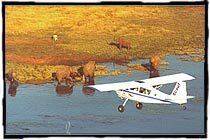 Wildcon's Zimbabwe "Scout" antipoaching aircraft, here flown by Dr. Bob Cleaves, patrols the north shore of the Matusadona National Park at Lake Kariba, providing protection for a small family of elephants.
WILDCON had four, two-seat light observation aircraft and one six-seat utility aircraft in antipoaching and humanitarian operations in southern Africa. Two are Bellanca 8GCBC "Scout" aircraft, two are American Champion 8GCBC "Super Scout" aircraft and the fifth was a Cessna U206F utility aircraft. With only five aircraft WILDCON had the largest "fleet" of dedicated antipoaching aircraft in government service in the world.

ZIMBABWE:
Historically our first aircraft was delivered on site in 1990, over two years before WILDCON was incorporated. It was assigned to the Zimbabwe Department of National Parks and Wildlife Management (NPWM) and was based at Hwange National Park, Main Camp, in northwestern Zimbabwe. Hwange NP is the largest park in Zimbabwe and is the home of the greatest number of elephants and rhinos in that nation. This aircraft patrols not only Hwange NP but also the reserves and parks that abut the Zambia border to the north and the Botswana border to the west. Our Zimbabwe Scout was, for more than five years, flown by NPWM Wildlife Officer and Acting Warden of Hwange NP, Crispin Jakopo, however, due to the demand by the highest level of the Botswana government of Zimbabwe that Crispin Jakopo use the aircraft, in part, to spot elephants, rhinos and other game animals for shooting inside national parks and wildlife reserves by government VIPs and their friends, Wilderness Conservancy withdrew the aircraft rather than allow it to be used as a “poaching” tool.
ZULULAND:
Our second aircraft was delivered on site in early 1992, several months before WILDCON was incorporated. It was assigned to the KwaZulu-Natal Nature Conservation Service (NCS), and was based at Empangeni near Richard's Bay in the central region of the Province of KwaZulu-Natal. It was flown by Wildlife Officer/Pilot Warren Ealdeck. It patroled all regions within KwaZulu-Natal inclusive of its border with Mozambique, Ndumu Game Reserve, Tembe Elephant Reserve, the Kosi Bay Estuary, the Indian Ocean dune forests and marine reserves, Lake Sibaya, Umfolozi, Hluhluwe and Mzuzi game reserves, Lake St. Lucia and the Drakensburg Mountain Reserves. This huge area is one of the few remaining jewels on the African continent bountiful with both black and white rhinos, elephants, lions, etc. The reserves of KwaZulu-Natal are home to the largest population of white rhinos (8,441) and endangered black rhinos (1,000+) in the world. In order to preserve it in its present condition it will require an additional aircraft.
SOUTH AFRICA'S KRUGER NATIONAL PARK:
Prior to the transition of government to majority rule, South Africa had maintained its wildlife and wild places reasonably well. However, the new government has placed emphasis on "people" rather than wildlife and wild places. Thus, funding for the National Parks Board has been cut drastically. South Africa's conservation effort welcomes help from external sources. In 1996 our third and fourth aircraft were delivered on site. These two aircraft (both funded by donations from the government of the Republic of China on Taiwan), were assigned to the National Parks Board of South Africa and were based at Skukuza in Kruger National Park (KNP). One was flown by Ken Maggs, head of antipoaching and investigations, and the other was flown Barry Roberts, wildlife officer and research scientist. KNP is a huge park/reserve and extends from Zimbabwe in the north, to Swaziland in the south. Its eastern border is Mozambique. These two aircraft shared the responsibility of protecting all wildlife in KNP as well as the adjacent wildlife areas outside which abut its western border. The two Super Scout aircraft were so successful that from their deployment in 1996 until early 1998 not one rhino or elephant had been poached in KNP. In December 1997 the NPB released one Super Scout from KNP for reassignment to Shamwari Game Reserve in the Eastern Cape. The other was transferred to Namibia where it is owned and flown by Carl Hilker in support of Namibian wildlife and the Cheetah Conservation Fund.
SHAMWARI GAME RESERVE, EASTERN CAPE:
Wildcon donated a Aeronca Champion aircraft to Shamwari Game Reserve near Port Elizabeth in the Eastern Cape, and it patrolled both the provincial, national and private game reserves in that province as well as the coastal marine reserves. Since its deployment, there have been no incidents of poaching of endangered or threatened wildlife. Shamwari has purchased a very large wilderness area in Cape Province and has traded the Scout for a helicopter so that landings can be made in the rugged bushveldt of the Eastern Cape to service water sources and to be used for darting and translocation of wildlife as well as antipoaching operations.
SOUTHERN AFRICA AND THE CESSNA UTILITY AIRCRAFT:
In July 1998 the fifth conservation aircraft, a six-seat STOL Cessna U206F, was delivered and placed into operation. It was in service with the Wildlife Breeding Resource Center (WBRC) and the South African Police Service (SAP) Endangered Species Protection Unit (ESPU). It was the only aircraft assigned to serve the ESPU and was based at the South African Police Service Air Wing facility at Wunderboom Air Base near Pretoria. (See ESPU and WBRC, below). The Cessna served so well that the ESPU was finally allowed to use government aircraft in its missions and the Cessna was returned to the USA where it now serves humanitarian and environmental missions flown out of Santa Monica airport, California, and into Baja California, Mexico (See Project CARE for details).
ESPU:
The ESPU is the world's leader in both internal and international operations against the illegal traffic in wildlife. It has received awards from the US Fish and Wildlife Service as well as several European and Asian nations. It also trains similar units in nine African nations.
The Cessna was being used to carry teams to various hot spots in South Africa as well as southern African nations who have enforcement agreements with South Africa. In addition, the SAP has a national responsibility to help serve social needs of rural people. Thus, in conjunction with the National Health Service and public and private university medical schools and hospitals, nearly every ESPU mission also served to carry medical and health supplies to rural clinics, as well as volunteer doctors.
WBRC:
WILDCON is presently involved in antipoaching operations designed to stop or at least slow the wanton killing of wildlife in the field. Early in 1997 WILDCON became aware of another approach to wildlife conservation that may well constitute a partial solution to long term wildlife survival. The Wildlife Breeding Research Center (WBRC), headed by Dr. Paul Bartels, is a working group of the South African based Endangered Wildlife Trust.
Assisted Reproduction Technology (ART) refers to techniques such as artificial insemination (AI), embryo transfer (ET) and in vitro (test-tube) fertilization (IVF). Genome Resource Banking (GRB), a term coined by the IUCN, refers to the collection, processing, storage (cryopreservation) and use of gametes (sperm and egg-cells), embryos and other biological materials from rare and endangered wildlife - in effect, a third (frozen) population is created, the other two being the populations found in the wild and in captivity.
ART can be used to produce embryos from egg-cells and sperm recovered from live or dead animals. The embryos can then be transferred to recipients (same or closely related species) or banked (frozen) for later use. WBRC is the only such facility on the African continent. It is located at Pelindaba, South Africa. The importance is simply this: Wildlife in Africa is no longer free to roam. Populations are being fragmented and placed on "islands" of land surrounded by game fences and people. The result is a dangerous loss of genetic exchange between populations. Inbreeding depression and genetic drift are evident: lions in Umfolozi Game Reserve are already being born with shorter legs; and black manned lions in Tanzania are all but extinct; elephants are being born without tusks in Zambia, Botswana and Zimbabwe. The ability to move genes between isolated populations through the use of ART and GRB and to thus breed and maintain populations in safe areas that might otherwise become extinct, is a significant development. The world's zoos and aquariums have a vast supply of genetic material which can be part of a two way exchange with those in the wild. Diversity as well as survival can be the result.
How does WILDCON fit in this picture? WBRC had been renting a Cessna 182 which it uses to collect materials from field operations, from hunters who have been trained to gather sperm and eggs from animals shot by their clients (within four hours following death), from farmers similarly trained, and from game departments. The cost of aircraft rental in Africa is extremely high. Thus, WILDCON has provided the WBRC with a Cessna U206 to WBRC free of use and thus relieve WBRC from the $50,000.00+ per year rental charges it presently incurs. WBRC already has a well qualified pilot, Frank Molteno, and will operate the Cessna U206 and share time with the ESPU. This project was an excellent adjunct to WILDCON's antipoaching program. The WBRC collects sperm, eggs and embryos from wild animal populations during capture or from dead animals and, through its Assisted Reproduction Technology (ART) (artificial insemination) and in vitro fertilization, has successfully propagated offspring in same or closely related species. ART and the WBRC Genome Resource Bank (GRB) represent a powerful conservation tool that is destined to play a major role in the conservation of a number of endangered wildlife species. WBRC is the only such facility on the African continent and is a leader in field operations that the Cessna serves. "Wildcon produces results!" RESULTS: During the first year of operation of the Zimbabwe Scout records were kept that reveal that the aircraft was directly responsible for the saving of 24 endangered black rhinos, locating for relocation 27 black rhinos, and apprehending 25 poachers. Including that first year, our five aircraft had, to date, been directly responsible for saving hundreds of rhinos (black and white), and thousands of elephants from the guns of poachers. Add to the foregoing the apprehension of more than 200 poachers.

| SummaryAntipoaching Aircraft * Ongava Reserve * Gorongosa Park Antipoaching Endorsements Computer Systems Game Scout Awards Equipment for Animal Studies Humanitarian Aircraft History Ongoing Programs Relocation of Wildlife School Supplies, Clothing and Toys Support Equipment for Antipoaching Aircraft |
CONTACT US:
|
| Home | About Us | Projects | News | Photos & Stories | Project CARE | Donate |
© Wilderness Conservancy 2001-2019 |